
DeSoto County Court Records
An arrest in DeSoto County first creates a custody record at the DeSoto County Adult Detention Facility. That record can show booking charges, bond, an arresting agency, a warrant number, or a case/control number when those fields are populated in the jail docket. It is still a jail record. The court record starts when the complaint, information, indictment, or other filing moves into Justice Court, County Court, or Circuit Court. The District Attorney for the 23rd Judicial District handles felony prosecution, while Justice Court judges sign warrants, set bond, hold preliminary hearings, and handle many misdemeanor and traffic matters tied to the Sheriff's Department or Mississippi Highway Patrol.
The difference matters because a booking charge may not be the final charge. A DeSoto County jail entry can later be amended, reduced, dismissed, indicted under a different count, or resolved in court. Custody and booking detail belongs with DeSoto County jail inmate records, while booking photos are treated separately on the DeSoto County jail mugshots page. Court records after an arrest are the better path for charge status, court dates, case numbers, disposition, and expunction research.
The county's public-records request policy explains that court records are routed to clerks, while police and arrest records go to the law-enforcement agency that created them.
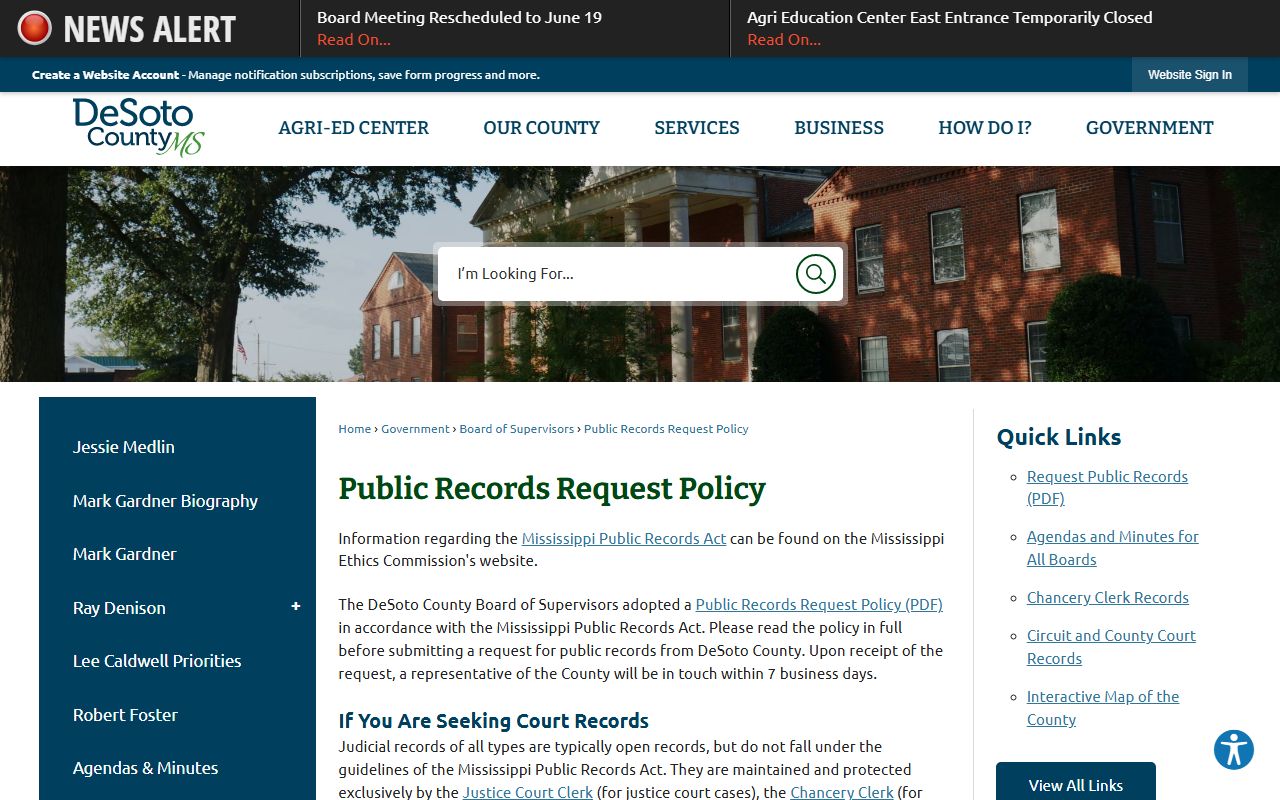
That routing is the key local rule: do not send a court-charge request to the Board of Supervisors when the clerk, MEC, Justice Court, or the arresting agency is the correct source.
Finding Records After Arrest
DeSoto County Circuit and County civil and criminal cases moved to Mississippi Electronic Courts after October 25, 2021. The county says the older AS400 subscriptions are no longer current for those records, and all users must register through MEC to access civil and criminal cases and judgment roll. The Circuit Clerk's public inquiry room also has computers for felony, civil, judgment roll, and marriage records on the first floor of the courthouse. County Court record requests route through the Circuit Clerk's Office at 662-469-8007.
- Start with the Mississippi Electronic Courts route for Circuit and County criminal cases after the county's MEC conversion date.
- Search by defendant name or case number when one is available from the jail docket, bond paperwork, or clerk.
- Open the matching case and read the filed charge list, court type, hearing history, and disposition fields.
- If the case is a pending Justice Court file, contact or visit the Justice Court Clerk rather than assuming the full file is online.
The county's Circuit Clerk public-records page is the local source for MEC routing and the registration requirement for DeSoto County civil and criminal cases.
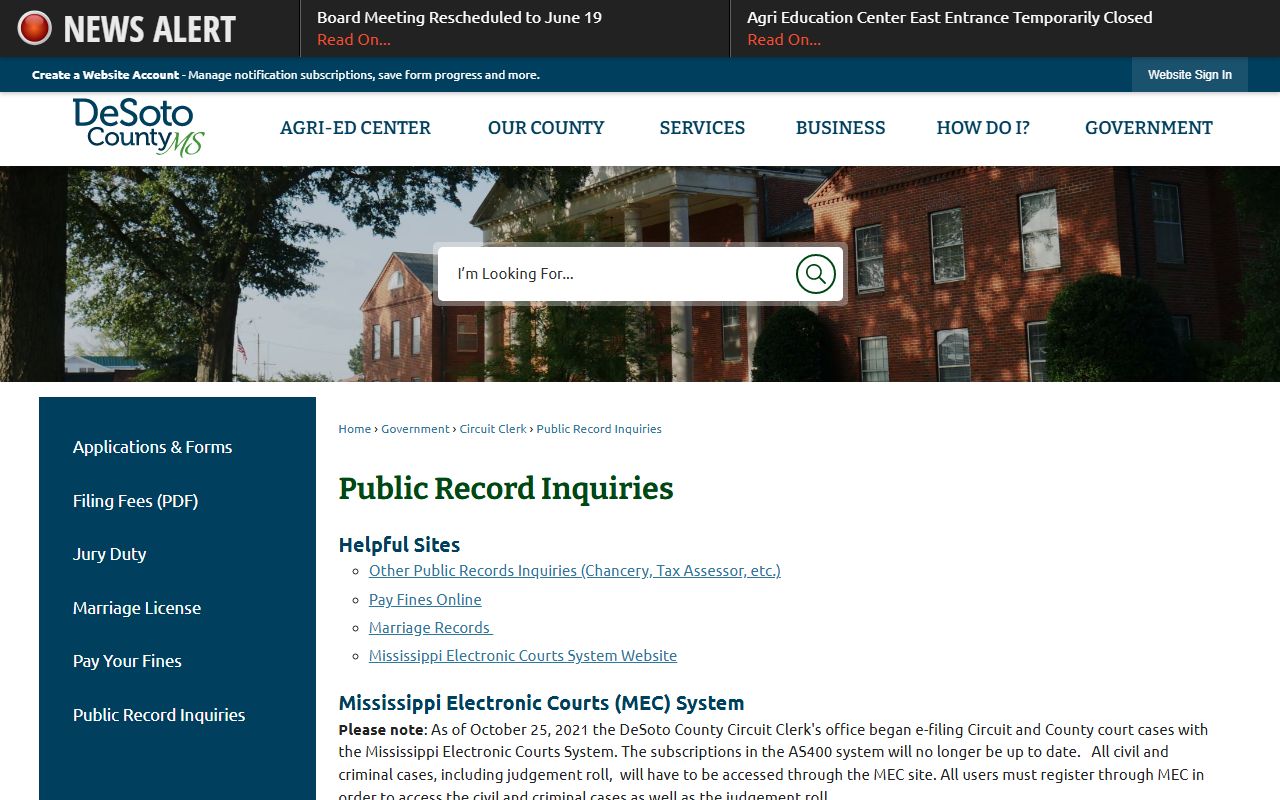
Use that court path when the question is what charge was filed, what hearing is next, or how the case ended after the arrest.
MEC and Justice Court Access
Justice Court has a separate role in DeSoto County arrest cases. Its judges sign warrants, set bonds, conduct felony preliminary hearings, and handle misdemeanor criminal and traffic cases within their jurisdiction. The public-records policy says Justice Court convictions can be found on the Justice Court public records webpage. If a Justice Court case has not been disposed, the person must go to the Justice Court Clerk to request to see the file.
| Access Point | Use It For | Local Detail |
|---|---|---|
| Mississippi Electronic Courts | Circuit and County civil/criminal cases | Registration required; county conversion date is October 25, 2021. |
| Circuit Clerk inquiry room | Felony, civil, judgment roll, and related public records | Public computers are available at the courthouse. |
| Justice Court case inquiry | Justice Court convictions and inquiry access | Pending files may require clerk access in person. |
| Jail docket | Booking charge, bond, and custody snapshot | Useful lead source, but not the final court record. |
The DeSoto County Justice Court page gives the local court role, address, phone, warrant and bond duties, case inquiry links, and public access rules.
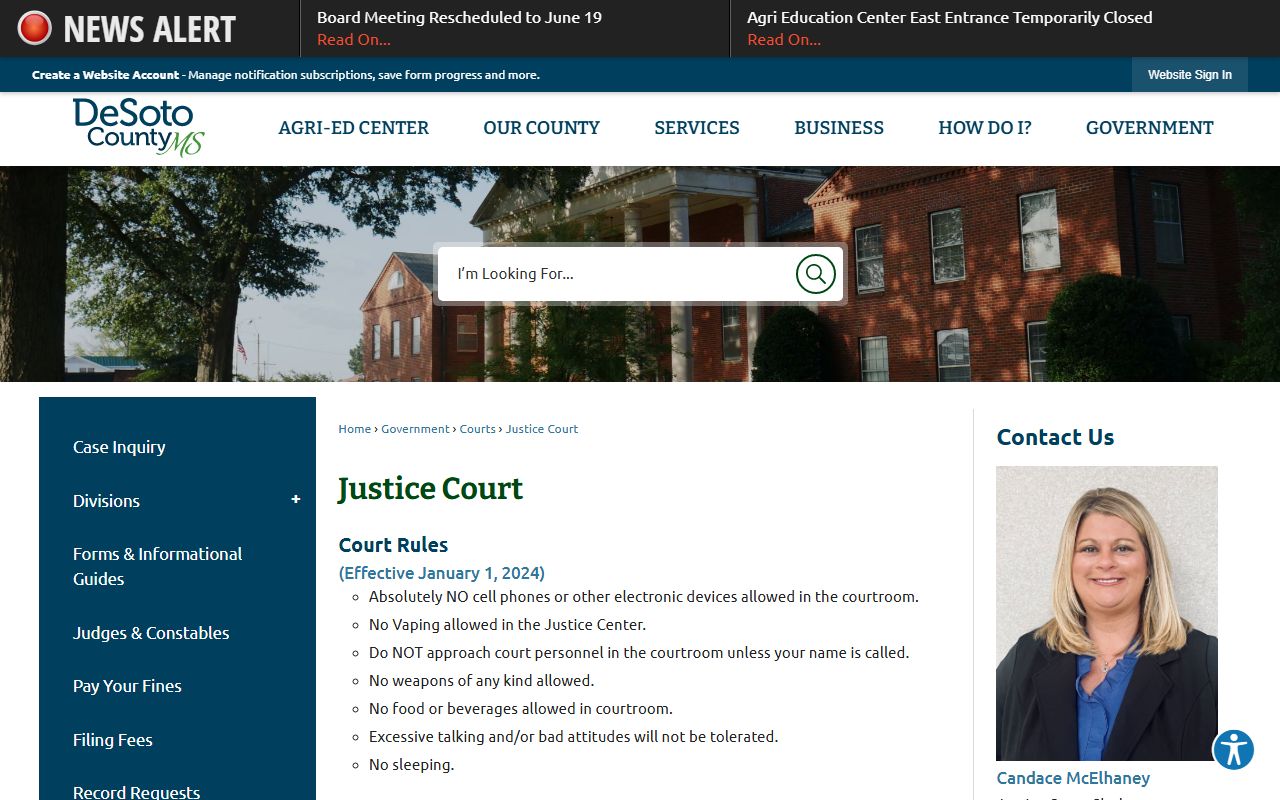
That court is often the first stop for warrant, bond, and preliminary-hearing questions before a felony case moves deeper into County or Circuit Court.
Charging Documents After Arrest
Formal charges can arrive through more than one document. A complaint is often an early charging statement in lower-court or first-stage proceedings. An information is filed by a prosecutor. An indictment is a grand jury charge and is common in serious felony practice. In DeSoto County, District Attorney Matthew Barton of the 23rd Judicial District is tied to the felony prosecution path, while Justice Court and County Court handle warrants, bond, and preliminary-hearing steps that may come first.
| Document | Who Files It | What It Means |
|---|---|---|
| Complaint | Officer or prosecutor | Begins or supports the court case, often at an early stage. |
| Information | Prosecutor | States the formal charge without a grand jury indictment where allowed. |
| Indictment | Grand jury | Charges an offense after grand jury review, often in felony matters. |
A jail docket charge is a lead, not a promise. It may help find the court file, but the court record controls the charge that is pending, dismissed, reduced, or disposed.
Charge Status After Arrest
Charge status changes as a case moves from arrest to court. A pending charge is still active. An amended or reduced charge means the prosecutor or court changed the count. Dismissed and nolle prosequi both point to a charge ending without a conviction, though the court record should be checked for the exact entry. Disposition is the final result. Conviction means guilt was entered by plea, verdict, or other lawful adjudication.
| Status | Plain Meaning | Why It Matters |
|---|---|---|
| Pending | The case or count is still active. | Bond, hearings, and warrants may still change. |
| Amended or reduced | The filed charge changed from the first listed charge. | The booking charge and court charge may no longer match. |
| Dismissed | The charge ended without conviction. | It may still appear as a court record unless sealed or expunged. |
| Nolle prosequi | The prosecutor declined to pursue that count. | It is not the same as a conviction. |
| Conviction | Guilt was entered by plea, verdict, or judgment. | Sentencing, probation, jail credit, or MDOC transfer may follow. |
Note: A court record can show no conviction even when a booking record remains visible in a separate custody or arrest-record system.
Bond After DeSoto Arrest
Bond information in DeSoto County starts with the jail docket because the county FAQ sends custody and bond questions there. Bond is still a court-controlled matter. Justice Court judges set bonds and conduct felony preliminary hearings, and County Court judges may also set bond and issue warrants. Mississippi law treats bail as a way to secure the person's appearance in court. A listed bond can also be affected by another hold, warrant, detainer, probation matter, immigration issue, or federal authority.
| Bond Type | How It Works |
|---|---|
| Cash bond | Money is posted as security for court appearance. |
| Surety bond | A bail agent signs the bond under Mississippi's commercial bail system. |
| PR bond | Release on recognizance, based on a promise to appear. |
| No-bond hold | A court or agency hold blocks release until the hold is cleared. |
Check the official jail docket first, then call the jail or the correct clerk before bringing funds or hiring a bondsman. Justice Court is at 3423 Industrial Drive W in Hernando and can be reached at 662-469-8026. County and Circuit Court record questions go through the Circuit Clerk at 662-469-8007. The District Attorney's Office is not the place to post bond.
Warrants and Court Records
No official DeSoto County public active-warrant search page was located in the research. The official sheriff page names Sheriff Bill Rasco, and the sheriff directory lists the Warrant Division and Fugitive Division at 662-469-8524. A warrant can be an arrest warrant, bench warrant, search warrant, fugitive warrant, extradition warrant, or lower-court warrant from a municipal or Justice Court matter. Once the person is arrested, the jail docket may show a warrant number, case number, control number, court date, arresting agency, bond field, or charge status if JailTracker displays those fields for that record.
For sheriff warrants, call the Warrant or Fugitive Division. For Justice Court criminal, traffic, bond, or preliminary-hearing issues, use the Justice Court inquiry route or call the clerk. For County and Circuit felony matters, use MEC or the Circuit Clerk. City cases should be checked with the municipal court for the city where the charge arose, such as Hernando, Horn Lake, Southaven, Olive Branch, or Walls.
Charge Versus Conviction
Being arrested or charged is not the same as being convicted. The DeSoto County jail docket can show an accusation at the custody stage. The court file shows whether the prosecutor filed a formal charge, whether the court accepted a plea, whether a trial produced a verdict, or whether the charge ended without conviction. Treat each field as part of a timeline, not as the whole case.
| Point | Charge | Conviction |
|---|---|---|
| Stage | Accusation after arrest or filing | Final guilt finding or accepted plea |
| Proof level | Probable cause or charging decision | Beyond a reasonable doubt or valid plea |
| Record source | Jail docket, complaint, information, or indictment | Court judgment, sentencing entry, or disposition |
Sealed Versus Expunged Records
Mississippi public-records law generally makes public records available unless an exemption applies, but criminal and court records can be limited by juvenile rules, sealing, expunction, active-investigation limits, or court order. Mississippi Code Section 99-19-71 sets out expunction rules for certain eligible matters. The effect of an expunction can be stronger than simple public-view restriction, but eligibility depends on the charge, disposition, prior record, waiting period, and court order.
| Record Action | Public View | Practical Meaning |
|---|---|---|
| Sealed | Hidden or restricted from routine public access | Some agencies or courts may retain access under law. |
| Expunged | Removed from ordinary public record treatment | The person may be restored to pre-arrest or pre-indictment status for that matter. |
| Not eligible | May remain public | Check the statute and court order before assuming removal. |
Note: A dismissal does not always erase every related jail, arrest, agency, and court entry without a separate expunction process.
Restricted DeSoto Court Records
Some records tied to an arrest are not open in the same way as ordinary adult criminal case entries. Juvenile matters, sealed cases, expunged records, active investigative files, and records covered by a specific court order can be withheld or redacted. Mississippi's Public Records Act, Title 25, Chapter 61, is the access starting point, but it does not override every exemption.
For DeSoto County, the routing rule remains local and specific. Court filings go through MEC, the Circuit Clerk, County Court channels, or Justice Court. Arrest reports and booking materials go to the Sheriff's Office or to the city police department that made the arrest. The Board of Supervisors policy gives a seven-business-day contact expectation for Board public-records requests, but the county policy also says court records and police/arrest records follow their own office routes.
Important: Do not use court, jail, or arrest records for employment, credit, housing, insurance, or any FCRA-covered decision.